

Disclosures
Disclosures brings together six black-and-white photographs taken following my arrival in Florence in 2020. During the silence of the second lockdown, the absence of tourists created a rare stillness, allowing me to encounter the city’s monuments without distraction — as enduring symbols of Florence’s historical and cultural identity.
In these images, iconic sculptures such as Cellini’s Perseus and the rearing horses of Ammannati’s Neptune emerge from the quiet, released from their role as backdrops to passing visitors. Stripped of spectacle, they seemed to reclaim their original presence and intention, revealing messages of political authority, civic pride, and social power embedded within their forms.
It was a humbling experience. I had arrived in the city knowing no one and having never been there before, and suddenly found myself alone within it. It felt like a magical experience as though I was there in secret, and I embraced those days fully. For almost six months I walked those streets, in various degrees of lockdown absorbing the depths of a city that, for a brief period, seemed to rest — granted a rare respite from the mass tourism that has steadily and increasingly engulfed it over recent decades.
The Disclosures pieces were introduced to the public in Florence for the first time in 2024 at an exhibition in the city overlooking the Ponte Vecchio. Alongside these works, I presented three colour photographs from Reimagining the Grand Tour reflecting on travel as education and cultural exchange. The exhibition also included the world premiere of two previously unseen works by Jack Vettriano, adding a personal and artistic dialogue within the space.
The overall theme of the exhibition centred on a conversation around the overpopulation of tourism in the city, introducing the Grand Tour project as a way to consider what we might learn from travellers of the past.

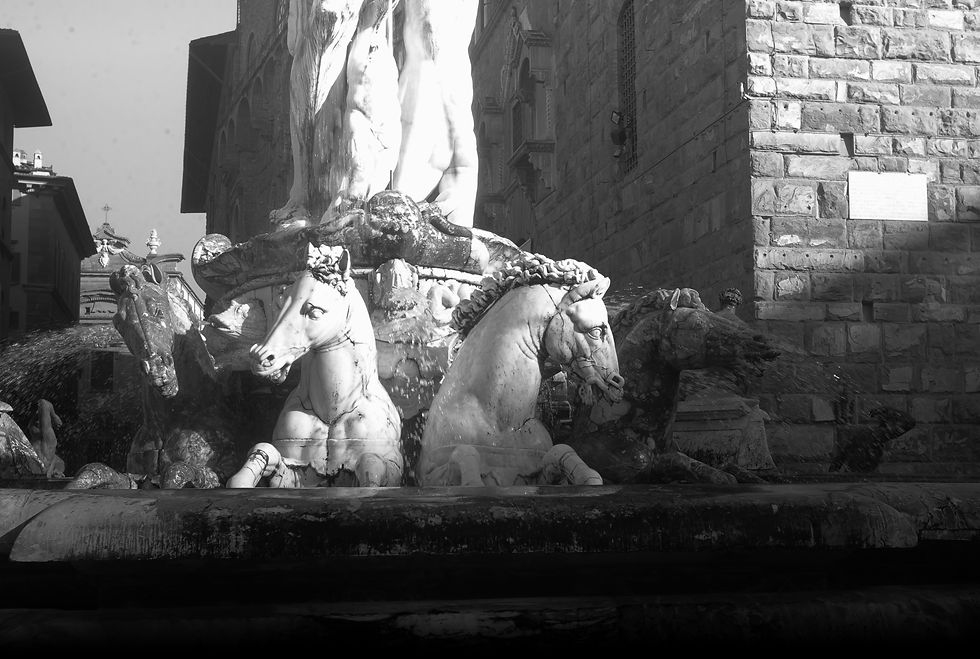


“The great square was in shadow, the sunshine had come too late to strike it. Neptune was already unsubstantial in the twilight, half god, half ghost, and his fountain splashed dreamingly to the men and satyrs who idled together on its marge. The Loggia showed as the triple entrance of a cave, wherein many a deity, shadowy, but immortal, looking forth upon the arrivals and departures of mankind. It was the hour of unreality – the hour, that is, when unfamiliar things are real.”
E. M. Forster, A Room With a View
With the awe, reverence and spirit of a first-time grand tourist, Grace Lambert -Phillips chose this hour of unreality to translate the timeless poetry of a city too often subjected to floods of noisy and indifferent bystanders. At this time, the figures of heroes and demi-gods regain their ascendancy over the Tuscan city, and the majesty, the harmony of the art and architecture of the Renaissance resurface, pure and sublimated by the long shadow of the soft twilight.
Grace Lambert-Phillips, captures these monumental images in a moment of calm and serenity. Places thus frozen can once again invite contemplation, exuding all the creative force that gave birth to them. One must never forget that Florence is a miracle the likes of which have only happened a few times in history. These treasures of art and architecture are only born from a unique constellation of will, talent, fortune and time which so seldom come together.
In addition to these squares inhabited by the gods, Lambert Phillips focuses the lens of her camera to the interiors of princely residences. The textures, colours, and inanimate objects evoke the existence of another, closer age, where refinement in all things still had its place. One can almost hear the whispers of a romantic conversation around a hidden door, the musical notes of a distant ball, the crunch of a silk dress on the steps of a marble staircase.
The gods dwell here, but we only pass through. May these photographs promote the poetry and eternal magic of this city and inspire admiration in all of us who pass by. I thank Grace for inviting us there.”
— Thierry Morel, Art Historian & Curator
